
What Investors Look For Beyond the Prototype: The Healthcare Startup Readiness Checklist

A working prototype is often the moment when a healthcare startup feels like it has finally arrived. The concept is no longer just a sketch or a presentation, it is something tangible that can be demonstrated to clinicians, investors, and potential partners.
But for experienced healthcare investors, a prototype is only the beginning.
Every year, thousands of medical technology startups are founded worldwide, yet only a small percentage successfully reach commercialization. According to industry research, nearly 90% of startups fail, and in healthcare, failure rates are even higher due to regulatory complexity, clinical validation requirements, manufacturing challenges, and long commercialization timelines.
The question investors ask is no longer, "Does the prototype work?" Instead, they ask, "Is this company ready to become a successful medical device business?"
This is where a Healthcare Startup Readiness Checklist becomes critical. It helps founders identify the gaps between an impressive prototype and an investment-ready company.
Why a Prototype Isn't Enough
A prototype demonstrates technical feasibility.
An investor, however, wants confidence that the device can survive every stage after development.
That includes:
Clinical validation
Regulatory approval
Manufacturing
Intellectual property protection
Market adoption
Financial scalability
According to MedTech Europe, developing a medical device from concept to commercialization typically takes 3–7 years, while high-risk devices may require 7–10 years before reaching the market.
That means investors are evaluating whether the startup can successfully navigate this journey, not simply whether the device turns on.
The Healthcare Startup Readiness Checklist
Below are the major factors investors evaluate before making funding decisions.
1. Is There a Real Clinical Problem?
Many founders begin by building an innovative product.
Successful healthcare startups begin by solving an important clinical problem.
Investors look for evidence that the problem has been validated through conversations with clinicians, hospitals, and healthcare providers.
A useful benchmark is conducting interviews with 20–50 clinicians or healthcare stakeholders before finalizing the product concept. These discussions often uncover workflow challenges, unmet needs, and purchasing barriers that cannot be identified through desk research alone.
If founders cannot clearly explain who experiences the problem, how often it occurs, and why existing solutions fail, investors quickly lose confidence.
2. Clinical Validation Beyond Assumptions
Healthcare products cannot rely on assumptions.
Investors want evidence.
This includes:
Pilot studies
Usability testing
Clinical feedback
Early performance data
Research shows that approximately 70–80% of medical device recalls involve design, manufacturing, or process-related issues, highlighting why early validation is essential.
Even small-scale clinical evaluations provide stronger credibility than theoretical market predictions.
3. Regulatory Strategy Is Already Planned
One of the biggest mistakes first-time founders make is treating regulatory approval as something to think about after development.
Experienced investors know this can delay commercialization by years.
They expect founders to understand:
Device classification
Applicable regulatory pathways
Required documentation
Risk management strategy
Verification and validation plans
Whether targeting FDA, CE Mark, or CDSCO approval, regulatory planning should begin during product development, not after the prototype is complete.
Ignoring regulatory requirements often results in expensive redesigns later.
4. Strong Intellectual Property Protection
A prototype without intellectual property protection is difficult to defend in a competitive market.
Investors look for:
Patent strategy
Freedom-to-operate analysis
Trademark planning
Confidential development processes
According to the World Intellectual Property Organization (WIPO), global patent filings exceeded 3.5 million applications in recent years, reflecting how competitive innovation has become.
Protecting intellectual property increases investor confidence while improving future company valuation.
5. Design for Manufacturing (DFM)
A prototype built in a laboratory is very different from a product manufactured at scale.
Investors evaluate whether the design is commercially manufacturable.
Questions include:
Can production costs remain competitive?
Are components readily available?
Can quality remain consistent across large production volumes?
Studies suggest that manufacturing decisions made during early development determine nearly 70% of a product's total lifecycle cost.
Design for Manufacturing significantly reduces future production risks.
6. A Clear Market Opportunity
Investors are not only investing in technology.
They are investing in market potential.
Founders should clearly define:
Total Addressable Market (TAM)
Serviceable Available Market (SAM)
Serviceable Obtainable Market (SOM)
Rather than claiming a "multi-billion-dollar healthcare market," investors expect precise customer segmentation.
For example, instead of targeting every hospital, a startup may initially focus on orthopedic clinics performing outpatient procedures.
Specific markets create stronger commercialization strategies.
7. A Sustainable Business Model
An outstanding product does not guarantee commercial success.
Investors want to understand how revenue will be generated.
Important considerations include:
Device pricing
Manufacturing margins
Distribution strategy
Hospital procurement process
Reimbursement pathway
Healthcare purchasing decisions often involve multiple stakeholders, including clinicians, procurement teams, administrators, and finance departments.
Understanding this buying process demonstrates commercial readiness.
8. An Experienced Team
Early-stage investors frequently state they invest in founders as much as products.
A technically brilliant idea can fail if the team lacks expertise in:
Engineering
Clinical practice
Regulatory affairs
Manufacturing
Business development
Research from several venture capital reports consistently shows that management capability remains one of the strongest predictors of startup success.
When expertise is missing internally, strategic advisors can significantly strengthen investor confidence.
9. Realistic Financial Planning
Medical device development is expensive.
Depending on device complexity and regulatory classification, development costs may range from $500,000 to more than $30 million before commercialization.
Investors expect realistic financial planning covering:
Product development
Clinical studies
Regulatory approval
Manufacturing setup
Marketing
Working capital
Overly optimistic budgets often indicate limited industry experience.
10. Risk Management Is Already Embedded
Risk management is not just a regulatory requirement, it is an investor expectation.
Founders should demonstrate how they identify and reduce risks throughout development.
Examples include:
Patient safety risks
Manufacturing risks
Supply chain risks
Cybersecurity risks (for connected devices)
Clinical usability risks
Standards such as ISO 14971 provide structured frameworks for medical device risk management.
A startup with documented risk planning appears significantly more investment-ready than one reacting to problems as they arise.
Common Reasons Healthcare Startups Lose Investor Interest

Investors frequently pass on promising startups for reasons unrelated to technology.
The most common issues include:
No validated clinical need.
Weak regulatory strategy.
Lack of intellectual property protection.
No manufacturing plan.
Unrealistic financial projections.
Limited understanding of the target customer.
Poor commercialization roadmap.
Many of these issues can be addressed before fundraising begins, saving both time and resources.
How Product Development Partners Strengthen Investor Readiness
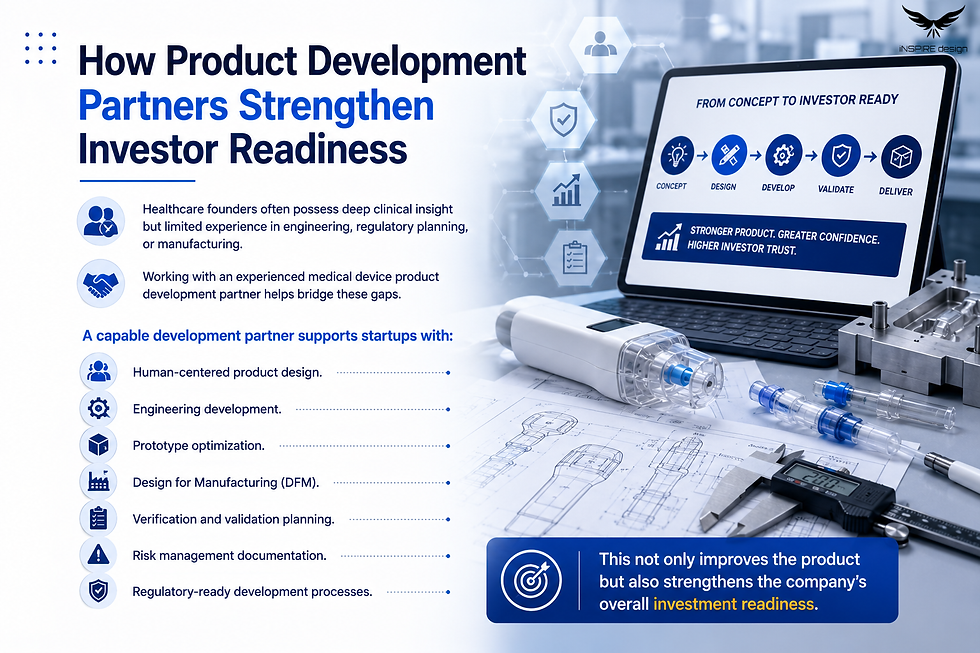
Healthcare founders often possess deep clinical insight but limited experience in engineering, regulatory planning, or manufacturing.
Working with an experienced medical device product development partner helps bridge these gaps.
A capable development partner supports startups with:
Human-centered product design.
Engineering development.
Prototype optimization.
Design for Manufacturing (DFM).
Verification and validation planning.
Risk management documentation.
Regulatory-ready development processes.
This not only improves the product but also strengthens the company's overall investment readiness.
Final Thoughts
The prototype may open the door to investor conversations, but it rarely closes the deal.
Healthcare investors evaluate whether a startup has the technical, clinical, regulatory, manufacturing, and commercial foundation required to succeed in one of the world's most demanding industries.
Following a comprehensive Healthcare Startup Readiness Checklist helps founders identify weaknesses before investors do. It transforms a promising prototype into a business capable of attracting funding, navigating regulatory pathways, and achieving long-term commercial success.
At Inspire Design, we work with healthcare startups to move beyond prototypes by developing medical devices that are engineered for manufacturability, aligned with regulatory requirements, and built around real clinical needs. From concept refinement and engineering to design optimization and development support, our goal is to help innovators create products that are not only functional but also investment-ready and positioned for successful commercialization
Schedule a call with our team to walk through your requirements and understand the most practical way to move forward.


Comments