
Product development is something many doctors use every day, but rarely see
- Kunal Bijlani
- Feb 6
- 5 min read
Most doctors don’t think about product development while working. And that makes sense. In the middle of a procedure, the focus is on the patient, the outcome, and the next clinical decision,not on how an instrument was designed or why a mechanism feels the way it does.
Yet product development quietly shapes almost every interaction a doctor has with a medical device.
It shows up when an instrument feels stable in the hand. When a joint moves the same way every time. When a device doesn’t demand extra attention during a critical step. When cleaning and reuse don’t introduce uncertainty. These experiences don’t happen by accident. They are the result of deliberate decisions made long before a device reaches the clinic.
Product development is the work behind those decisions. It’s something doctors rely on every day, even though they rarely see it.
Where product development really begins
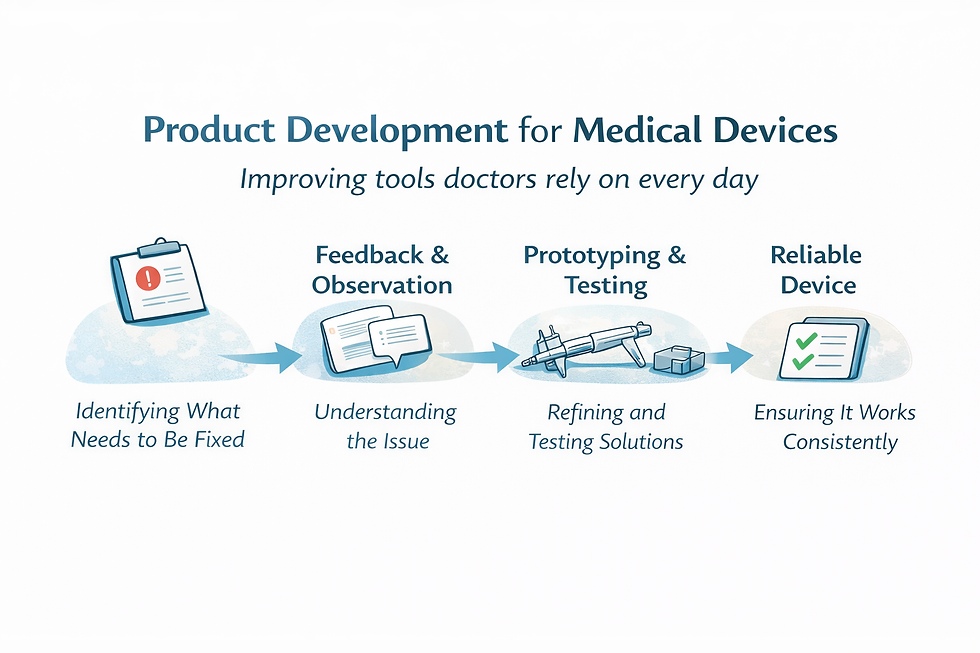
Product development rarely starts with a sketch or a CAD model. In medical devices, it usually begins with a clinical moment that feels slightly off.
A doctor might say, “This works, but it doesn’t feel consistent.” Or, “I’ve learned to adjust my grip here.” Or, “I slow down at this step because I’m not fully confident.”
These are not dramatic failures. They’re subtle signals. And they’re some of the most valuable inputs in product development.
From an engineering perspective, these comments point to specific questions. Why does the feel change? Where does inconsistency come from? Is it related to force transmission, alignment, tolerance stack-up, or wear over time? What looks like a general discomfort often traces back to a very specific mechanical or material issue.
Product development is the process of translating these clinical observations into engineering clarity.
Why “it looks simple” is often misleading
Many medical devices appear simple on the outside. A handheld instrument. A clamp. A cutter. A guide.
But inside that apparent simplicity are multiple components working together. Springs, pivots, fasteners, sliding interfaces, stops, and surfaces that must interact reliably under repeated use. Each part has to be designed not just to function, but to function together, consistently, and predictably.
A small handheld surgical instrument, for example, may contain a handle assembly, a linkage mechanism, a locking feature, return springs, and alignment features,all within a compact form. Each component affects the others. A slight change in one dimension can alter force, feel, or reliability across the entire device.
Product development is the discipline of managing this complexity so the doctor doesn’t have to think about it.
Prototypes are not about appearance
One common misconception is that prototypes exist to show what a device will look like. In reality, early prototypes are built to answer questions.
Does the mechanism behave the same way every time? Is the movement smooth or does it bind under certain conditions? Does the force feel predictable across repeated cycles? Does the device tolerate real handling, not just ideal use?
Early prototypes are often rough, sometimes unattractive, and intentionally incomplete. Their purpose is learning. Each version reveals something that wasn’t obvious on paper.
Doctors who test these prototypes often provide feedback that goes far beyond aesthetics. They notice subtle differences in balance, resistance, and control. This feedback directly shapes the next iteration.
Product development progresses through these cycles of build, test, observe, and refine.
Consistency is the real goal
In clinical practice, consistency matters more than novelty. A device that behaves slightly differently each time creates cognitive load. It asks the doctor to compensate, adjust, and stay alert to the tool instead of the procedure.
Product development focuses heavily on repeatability. Not just whether a device works once, but whether it works the same way across multiple units, multiple uses, and over time.
This involves careful attention to tolerances, materials, wear surfaces, and assembly methods. It also involves understanding how a device is cleaned, sterilized, stored, and reused. A mechanism that works perfectly on day one but degrades after repeated cycles is not clinically reliable.
When doctors say, “I don’t have to think about it,” that’s often the result of strong product development.
Why doctors’ feedback is different from user feedback
Clinical feedback is not the same as general user feedback. Doctors don’t usually describe problems in technical language. They describe experiences.
“It feels heavy here.”
“I hesitate at this step.”
“I don’t fully trust the lock.”
Product development is about listening carefully to these statements and asking the right follow-up questions. What exactly is happening at that moment? What changes in hand position, force, or orientation? What is the device doing mechanically when the discomfort appears?
This translation,from experience to engineering insight,is one of the most important parts of the process.
Product development is not just design
Design is only one part of product development. The larger process includes understanding clinical context, defining functional requirements, developing mechanisms, testing behavior, refining details, and ensuring the device can be manufactured reliably.
A device that works beautifully as a one-off prototype may fail when produced in volume if manufacturing variation isn’t considered early. Product development accounts for this reality. It asks whether a design can be repeated, assembled, and maintained without losing its intended behavior.
This is especially important for medical devices, where variability can directly affect clinical confidence.
When product development is done well, it disappears
The best product development is often invisible. Doctors don’t notice it because there’s nothing to notice. The device feels natural. It behaves as expected. It supports the procedure without demanding attention.
In those moments, product development has done its job.
The device becomes an extension of the clinician’s intent rather than an object that needs managing.
Why this matters for doctors involved in innovation
Many doctors are deeply involved in improving tools and workflows. They see opportunities for better instruments, safer mechanisms, or more intuitive designs. But translating those ideas into reliable products requires a structured development process.
Understanding what product development actually involves helps align expectations. It explains why iteration takes time, why early versions may feel unfinished, and why small details receive so much attention.
Product development is not about slowing innovation. It’s about making sure ideas survive real-world use.
The unseen work behind everyday tools
Every medical device carries a history of decisions, tests, adjustments, and refinements. Most of that work happens far from the clinic. Yet its impact is felt every day.
Product development is the reason a device feels predictable instead of uncertain. It’s the reason a mechanism inspires confidence instead of hesitation. It’s the reason doctors can focus on care rather than compensating for tools.
It may be rarely seen, but it is constantly at work.
And when it’s done right, it allows doctors to do what matters most,without distraction.


Comments