
ISO 13485 Certification in India: 7 Cost & Timeline Factors Medical Device Companies Should Budget For


A medical device startup has spent months developing its product.
The prototype works. Suppliers are being shortlisted. Manufacturing conversations have started. Then comes another line in the commercialisation plan:
ISO 13485 certification.
Someone adds a certification fee to the budget and a few weeks to the timeline.
That number may turn out to be the least interesting part of the calculation.
Because the real cost of ISO 13485 certification in India isn't determined by one certificate fee. It depends on the size and scope of the organisation, the complexity of its medical devices, the maturity of its Quality Management System (QMS), the number of audit days required, outsourced processes, the gaps identified during audits and, importantly, how much of the work has to be fixed after product development is already underway.
ISO 13485:2016 remains the current edition of the standard; ISO confirmed it again in 2025. It specifies requirements for a quality management system for organisations involved in medical devices. ISO For Indian medical device companies planning certification, therefore, the more useful question isn't:
“How much does ISO 13485 certification cost?”
It is:
“What will determine how much time and money we need to become certification-ready?”
And there are at least 7 factors worth budgeting for.
First: ISO 13485 Certification Cost Is Not One Number
A useful way to think about the budget is:
ISO 13485 Budget = QMS Preparation + Documentation + Implementation + Training + Certification Audit + Gap Closure + Ongoing Surveillance
The certification-body quotation is only one part of that equation.
For medical device companies that are still developing their first product, there can also be an indirect cost hiding underneath it:
product-development decisions that don't align well with the processes the QMS eventually needs to control.
That is why ISO 13485 shouldn't suddenly appear on the project plan a few weeks before an audit.
1. Your Team Size Directly Influences the Starting Audit Time
This is one of the most useful numbers for founders to understand.
Under IAF MD 9:2023, the starting audit time for an initial ISO 13485 certification audit-Stage 1 and Stage 2 combined-is linked to the organisation's effective number of personnel. ISO India
ISO 13485 Initial Audit Time by Effective Personnel
Effective personnel | Stage 1 + Stage 2 starting audit time |
1–5 | 3 days |
6–10 | 4 days |
11–15 | 4.5 days |
16–25 | 5 days |
26–45 | 6 days |
46–65 | 7 days |
66–85 | 8 days |
86–125 | 10 days |
126–175 | 11 days |
176–275 | 12 days |
The table continues for larger organisations, reaching 25 audit days for 8,501–10,700 effective personnel, with further progression beyond that.ISO India

This immediately explains why asking another medical device founder, “How much did your ISO 13485 certification cost?” doesn't necessarily give you a useful budget.
Their organisation may require a different number of audit days before we even consider product complexity.
2. Device Complexity Can Increase Audit Time
Two medical device companies with the same number of employees don't necessarily require the same audit effort.
IAF MD 9 specifically identifies medical-device complexity as a factor that can increase audit time. It also requires additional time when more than one main technical area needs to be audited. ISO India That distinction matters.
A company developing a relatively straightforward non-active device may present a different audit scope from an organisation working across electronics, software, sterile products or multiple medical-device technologies.
This is where founders sometimes make the mistake of treating ISO 13485 as a documentation exercise.
It isn't just:
Do we have the SOP?
The more important question is:
Does the QMS actually reflect how this company designs, develops, manufactures and controls its medical devices?
The complexity of the product and the complexity of the system used to create it are connected.
3. Outsourcing Manufacturing Doesn't Automatically Remove the QMS Work
This is particularly relevant for Indian startups.
A company may have a five-person internal team and outsource PCB manufacturing, moulding, machining, sterilisation, assembly or another critical process.
On paper, the organisation looks small.
Its supply chain may not be.
IAF MD 9 specifically identifies manufacturers using suppliers for processes or parts critical to device function or user safety as a factor that can increase audit time. Where sufficient evidence of supplier conformity cannot be provided, additional time may be required to audit suppliers.ISO India
That makes supplier control more than a procurement question.
Consider what happens during product development.
A component is selected because the supplier can deliver it quickly.
Another vendor produces the first prototype batch.
A third manufacturer takes over when volumes increase.
Specifications change through WhatsApp messages and email attachments.
Six months later, the company begins formalising its QMS.
Now somebody has to reconstruct:
Which specification was approved?
Which supplier was qualified?
What changed between versions?
How was the change evaluated?
Who approved it?
This is where good product-development discipline and quality-system readiness begin to overlap.
4. The Biggest Timeline Variable May Be How Much of the QMS Already Exists
Certification does not begin with an auditor arriving at the factory.
Before certification, the organisation needs a functioning QMS appropriate to its scope.
That means documented processes need to exist, but more importantly, those processes need to be implemented and generating evidence.
For a medical device company, that can touch areas such as document and record control, design and development controls where applicable, supplier management, risk-related processes, production controls, complaints, corrective and preventive action, traceability and other processes relevant to the organisation's activities.
So there is a significant difference between:
“We need to write our ISO 13485 documents.”
and:
“We have been operating through a controlled QMS and can demonstrate that it works.”
The first company may still have substantial implementation work ahead.
The second is much closer to being audit-ready.

The actual elapsed timeline depends heavily on where the organisation starts and what issues are identified.
5. Stage 1 and Stage 2 Are Not the End if Significant Gaps Are Found
The initial certification audit typically involves Stage 1 and Stage 2, but budgeting only for the audit dates misses an important variable: what the auditor finds.
If the QMS isn't adequately implemented, issues need to be addressed.
And this is where the difference between an early gap and a late gap becomes important.
A missing document can be a documentation problem.
A poorly controlled product-development process can become something much bigger.
Suppose an organisation discovers that key product requirements weren't adequately controlled.
That can raise questions around the design decisions built on those requirements.
If a critical supplier hasn't been appropriately controlled, the issue can extend beyond the supplier file to the parts or processes they provided.
If a manufacturing process requires validation, discovering that requirement after production planning has advanced can affect far more than one SOP.
The cost of closing a gap depends on what that gap touches.
That's difficult to represent in a certification quotation.
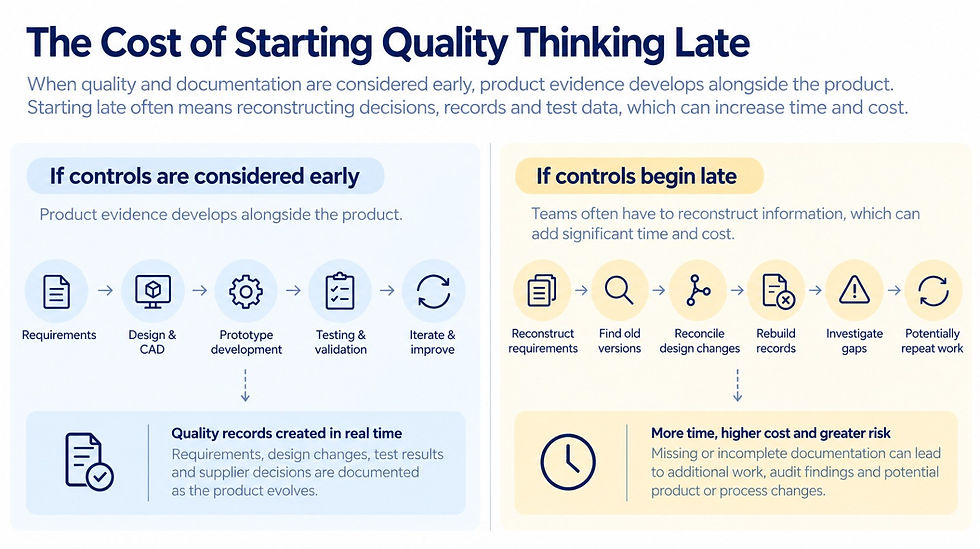
6. Product Development Can Either Support ISO 13485 Readiness-or Create More Work Later
This is the factor I think medical device founders underestimate most.
ISO 13485 and medical device product development are not the same thing.
But for companies responsible for design and development, many activities occurring during product development eventually need to fit within controlled QMS processes.
Requirements evolve.
CAD changes.
Materials change.
Prototypes fail.
Suppliers change.
Testing reveals new information.
Manufacturing feedback leads to another design iteration.
None of those things are inherently a problem.
The problem begins when the company cannot reliably reconstruct what changed, why it changed, what the impact was and which version is actually approved.
A lot of early-stage teams think quality documentation starts once the product is almost ready. But by that point, hundreds of engineering decisions have already been made. If requirements, design iterations, testing and supplier decisions have been handled systematically from the beginning, you're not trying to reconstruct the product's history later.”
This doesn't mean every early prototype needs the bureaucracy of a mature manufacturing organisation.
It means design discipline scales better than design archaeology.
7. Certification Is Not a One-Time Cost
This deserves a place in the budget because companies naturally focus on getting the certificate.
ISO 13485 certification is not simply:
Pay → Audit → Certificate → Done.
Accredited management-system certification operates on a certification cycle involving continued surveillance and recertification activities. Your certification body should set out those ongoing audit and fee requirements in its proposal.
So when comparing certification-body quotations, don't compare only the initial number.
Ask what the quotation includes.
Does it cover Stage 1 and Stage 2?
How many audit days have been calculated?
Are travel and related expenses separate?
What happens if additional audit time is required?
What are the surveillance costs?
What is included or excluded from corrective-action follow-up?
What happens at recertification?
The cheapest initial quotation is not automatically the lowest three-year cost of maintaining certification.
So, How Much Should You Budget for ISO 13485 Certification in India?
There is no single defensible rupee figure that applies to every Indian medical device company.
A more useful budget has four buckets:
1. QMS Readiness
Gap assessment, internal resources, documentation, implementation, training and any external quality/regulatory support required.
2. Certification
Stage 1 and Stage 2 audit fees, determined in part by required audit time and the certification body's commercial rates.
3. Gap Closure
Corrective actions, additional work and potentially product/process changes arising from issues identified before or during certification.
4. Maintenance
Surveillance audits, QMS upkeep, training, internal audits, process improvements and eventual recertification.
7 ISO 13485 Cost & Timeline Factors at a Glance
Factor | What can change |
1. Effective personnel | Influences the starting number of audit days |
2. Device complexity | Can increase required audit effort |
3. Technical areas | Multiple technical areas can increase audit time |
4. Critical suppliers & outsourcing | May increase audit effort and supplier-control work |
5. QMS maturity | Determines how much preparation and implementation is still required |
6. Audit findings | Corrective actions can add time and internal/external cost |
7. Ongoing certification cycle | Surveillance and recertification create continuing costs |
IAF MD 9 explicitly identifies personnel, technical areas, medical-device complexity and critical suppliers among the factors used to determine initial ISO 13485 audit time. ISO India
The Better Question to Ask Before ISO 13485 Certification
If you are developing a medical device in India, don't wait until somebody asks for the certificate to begin thinking about the systems behind it.
Ask earlier:
What needs to be controlled while we develop this product?
Which requirements are we designing against?
How are design changes being captured?
How are prototype versions identified?
How are engineering decisions recorded?
How are suppliers and critical components being managed?
How will we demonstrate what was tested?
How does the manufacturing version connect back to the approved design?
Those questions are useful even before an auditor enters the picture.
Because ISO 13485 certification doesn't create a well-controlled medical device development process.
Ideally, it verifies that one exists.
Should ISO 13485 planning start before the medical device is fully developed?
For organisations responsible for medical device design and development, considering QMS requirements early can make it easier to maintain controlled requirements, design records, testing evidence, supplier information and changes as the product evolves.
Building the Product While Building the System Around It
Across 60+ healthcare product development projects, one pattern we've repeatedly seen at Inspire Design is that the product rarely moves in a straight line.
Requirements change. Prototypes reveal problems. Engineering decisions evolve.
Suppliers provide feedback. Manufacturing introduces another set of constraints.
That iteration is part of building a medical device.
The important thing is making sure the product doesn't evolve faster than the team can understand and control it.
At Inspire Design, our role isn't to act as your ISO 13485 certification body or replace your quality and regulatory consultants. We work on the product side-medical device design, engineering, prototyping and Design for Manufacturing-while helping teams develop products with the discipline needed for the stages that come next.
If you're developing a medical device and preparing for manufacturing, certification or both, it is worth getting the product-development foundations right early.
FAQs: ISO 13485 Certification in India
1. What is ISO 13485:2016?
ISO 13485:2016 is an internationally recognised quality-management-system standard specific to the medical-device sector. The 2016 edition was reviewed and confirmed in 2025 and remains current.ISO
2. How much does ISO 13485 certification cost in India?
There is no single universal certification price. Costs depend on factors including certification-body rates, required audit time, organisation size and scope, device complexity, QMS readiness, audit findings and ongoing surveillance requirements.
3. How many audit days does ISO 13485 certification require?
IAF MD 9 provides a starting table for an initial Stage 1 + Stage 2 audit. For example, 1–5 effective personnel corresponds to 3 audit days; 6–10 to 4 days; 16–25 to 5 days; 46–65 to 7 days; and 86–125 to 10 days before applicable adjustments.ISO India
4. Can ISO 13485 audit time increase?
Yes. IAF MD 9 identifies factors including multiple main technical areas, medical-device complexity and reliance on suppliers for critical processes or components as reasons audit time may increase.ISO India
5. Does outsourcing manufacturing make ISO 13485 simpler?
Not automatically. Outsourced critical processes and components still need appropriate control, and IAF MD 9 specifically recognises critical suppliers as a factor that can affect audit time.ISO India
6. Is ISO 13485 only for medical device manufacturers?
No. ISO describes the standard as relevant to organisations involved in stages of the medical-device lifecycle and associated activities; the exact certification scope depends on the organisation. ISO
Disclaimer: This article provides general information about ISO 13485 and medical device product development. It is not certification, regulatory or legal advice. Certification requirements, audit duration and costs depend on the organisation, certification scope, certification body, applicable accreditation requirements and individual circumstances.
About the Author
Kunal Bijlani is the Co-founder of Inspire Design, a product design and engineering company working with clinicians, startups and healthcare companies on medical device design and development.
Through Inspire Design's work across 60+ healthcare product development projects, Kunal has worked with teams moving from early clinical ideas through product design, engineering, prototyping and Design for Manufacturing.
His focus is on bringing user needs, engineering realities and manufacturing requirements into the product-development process early-before late-stage changes make them significantly harder to solve.
Comments